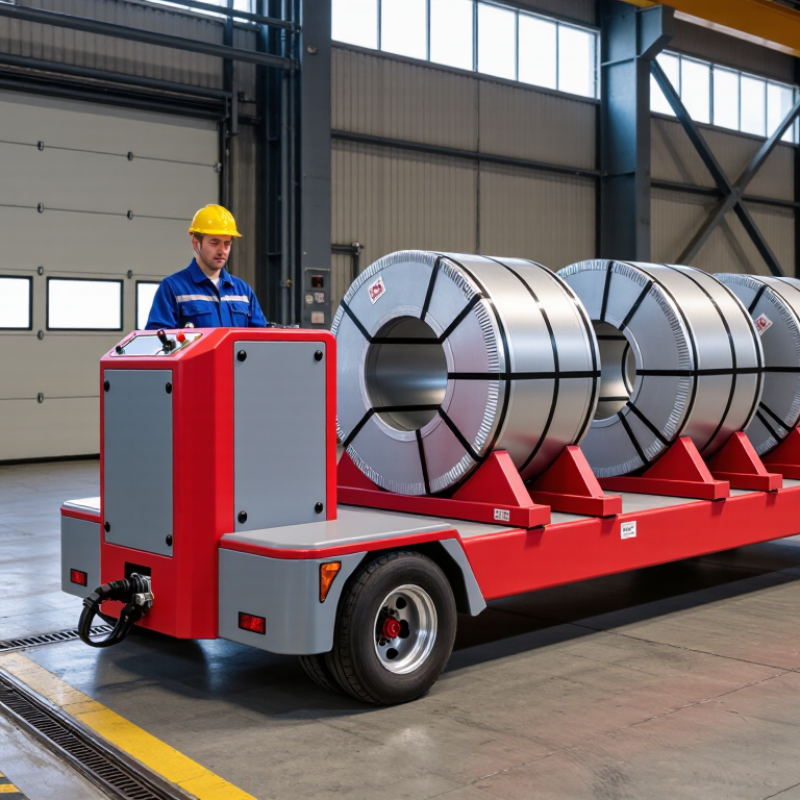
| Rated Load Capacity | Confirm the maximum combined load, including the workpiece, fixture, pallets, tools, and any temporary supports. | The rated capacity should exceed the calculated maximum working load with a documented engineering safety margin. The load must remain within the manufacturer’s center-of-gravity limits. | Signed load calculation, capacity plate, structural calculations, and a controlled full-load test. | Critical |
| Load Distribution and Center of Gravity | Check whether the cart remains stable when the load is offset, raised, rotated, or placed near an edge. | The center of gravity should remain inside the specified stability envelope during straight travel, steering, stopping, and emergency braking. | Stability assessment, load-position drawings, tilt or uneven-floor testing, and documented operating limits. | Critical |
| Steering and Directional Control | Evaluate turning radius, steering accuracy, response delay, travel path, and control behavior during forward and reverse movement. | Steering should be predictable and fail-safe. The cart should not move unexpectedly after a control signal is released or interrupted. | Functional test under no-load and rated-load conditions; review of the control-system risk assessment. | Critical |
| Service Brake and Parking Brake | Verify controlled stopping on the maximum intended gradient and secure parking when power is removed. | The cart should stop within the documented stopping distance at the maximum operating speed and hold its rated load when parked. | Braking-distance test, gradient test, brake-hold test, and inspection of spring-applied or equivalent fail-safe functions. | Critical |
| Emergency Stop System | Check emergency-stop locations, accessibility, reset behavior, and whether the stop function removes hazardous motion. | Emergency stops should be readily accessible from operating and loading positions. Resetting the device must not automatically restart the cart. | Emergency-stop circuit validation, reset test, wiring diagram, and safety-function verification. | Critical |
| Obstacle Detection and Collision Avoidance | Verify scanners, bumpers, contact edges, warning zones, and detection performance for people, vehicles, walls, and low-level obstacles. | Detection zones should be suitable for the cart’s speed, braking distance, load overhang, and site layout. Protective devices should initiate stopping before contact. | Detection-zone map, stopping-distance calculation, sensor validation, and tests with representative obstacles. | Critical |
| Speed Control | Confirm that speed can be limited by operating mode, direction, location, load condition, and proximity to people. | Use the lowest practical speed for the route. A reduced-speed zone should be available for loading areas, crossings, turns, and pedestrian interaction. | Speed-setting records, tachometer verification, zone-control test, and review of the site traffic risk assessment. | High |
| Audible and Visual Warnings | Check horns, beacons, travel-direction lights, warning displays, and alarms in the actual workplace noise and lighting conditions. | Warnings should be clearly distinguishable from ambient noise and lighting. Visual signals should remain visible from expected pedestrian approaches. | Measured sound-level assessment, visibility check, alarm-function test, and documented warning meanings. | High |
| Pedestrian Protection | Review pinch points, crushing hazards, shear points, exposed wheels, under-ride risks, and clearance around the cart. | Install guards, skirts, contact-sensitive edges, or other protective measures wherever a person could be trapped or struck during normal operation. | Machine risk assessment, guarding inspection, clearance measurements, and pedestrian interaction trials. | Critical |
| Travel Path and Floor Conditions | Confirm floor load rating, flatness, joints, gradients, drainage, rail crossings, door clearances, and turning-space requirements. | The route should support the fully loaded cart without excessive deflection, wheel slip, loss of steering control, or contact with fixed structures. | Site survey, floor-capacity documentation, route drawing, gradient measurement, and loaded route trial. | Critical |
| Battery and Charging Safety | Verify battery type, protection against overcurrent and overtemperature, charging location, ventilation, connector protection, and access control. | Charging should occur in a designated area with suitable electrical protection, ventilation where required, spill-control provisions for applicable batteries, and restricted access. | Battery and charger specifications, electrical test certificates, charging procedure, and inspection records. | Critical |
| Electrical Protection | Inspect isolation, grounding or protective bonding, short-circuit protection, enclosure rating, cable routing, and protection against unintended energization. | Electrical equipment should be designed for the site environment and protected against mechanical damage, moisture, dust, and unauthorized access. | Electrical schematics, insulation and continuity tests, enclosure documentation, and lockout/tagout instructions. | Critical |
| Safety-Related Control System | Determine the required performance level for emergency stop, braking, speed limitation, obstacle detection, and restart prevention. | Safety functions should be validated against the risk assessment and designed to an appropriate performance level under ISO 13849-1 or an equivalent safety-control methodology. | Safety requirements specification, circuit diagrams, validation report, fault-response test, and component data. | Critical |
| Control Modes and Unauthorized Use | Review handheld controls, key switches, access codes, dead-man controls, automatic mode, manual mode, and maintenance mode. | Only trained and authorized personnel should be able to operate or configure the cart. Loss of the control signal should result in a safe state. | Access-control test, operator authorization procedure, control-loss test, and mode-selection documentation. | High |
| Communication and Remote Control | For wireless or networked carts, check signal loss, interference, cybersecurity controls, communication range, and command authentication. | Loss, delay, corruption, or interruption of communication should not create uncontrolled motion. Remote commands should be authenticated and traceable where applicable. | Communication-loss test, radio survey, access-control configuration, event logs, and cybersecurity risk assessment. | High |
| Manual Recovery and Towing | Verify how the cart can be moved after battery depletion, control failure, obstruction, or emergency shutdown. | Provide documented recovery points, towing limits, wheel-release procedures, and controls that prevent unintended movement during recovery. | Recovery procedure, towing-capacity documentation, brake-release test, and supervised recovery drill. | High |
| Noise, Vibration, and Ergonomics | Assess operator exposure, pedestrian comfort, vibration transmitted to the load, visibility, control placement, and manual handling requirements. | Controls should be reachable and clearly labeled. Noise and vibration should be assessed against applicable workplace exposure requirements and the load’s sensitivity. | Noise and vibration measurements, ergonomic review, operator trial, and maintenance records. | Standard |
| Fire and Hazardous-Area Suitability | Determine whether the cart will operate near flammable liquids, combustible dust, hot surfaces, corrosive materials, or oxygen-enriched environments. | Do not use a standard cart in a classified hazardous area unless the complete system is specifically approved and installed for that area. | Area classification, equipment suitability documentation, ignition-source assessment, and site approval. | Critical |
| Guarding and Mechanical Integrity | Inspect frames, welds, axles, wheels, steering mechanisms, lifting points, covers, fasteners, and load-contact surfaces. | All structural and moving components should be rated for the intended duty cycle, fatigue exposure, impact loads, and environmental conditions. | Engineering drawings, material and weld records, inspection plan, overload test where applicable, and preventive-maintenance schedule. | Critical |
| Documentation and Operator Training | Check manuals, warnings, capacity information, inspection intervals, emergency procedures, and training requirements. | Documentation should be available in the operating language and should define authorized uses, prohibited loads, route limits, charging, maintenance, and emergency response. | Operating manual, maintenance manual, training records, inspection checklist, and posted operating instructions. | High |
| Applicable Compliance Framework | Identify the legal requirements for the country, installation site, electrical supply, machinery category, and operating environment. | Use a documented compliance matrix. Common references may include ISO 12100 for risk assessment, ISO 13849-1 for safety-related controls, IEC 60204-1 for electrical equipment, ANSI B56.5 or ISO 3691-4 for applicable driverless industrial truck functions, and local occupational-safety rules. | Declaration or conformity documentation where applicable, risk assessment, standards checklist, test reports, and authority or site acceptance records. | Critical |
| Inspection and Preventive Maintenance | Confirm inspection frequency for brakes, steering, wheels, sensors, emergency stops, batteries, structural parts, and safety labels. | Implement pre-use checks, periodic inspections, defect reporting, corrective-action tracking, and maintenance based on duty cycle and manufacturer instructions. | Inspection forms, maintenance schedule, service history, defect logs, and revalidation records after safety-related changes. | High |