
Language:

China Top 10 HDBaseT Extender Manufacturers?

China’s HDBaseT market has grown from a specialist AV segment into a practical source for schools, hotels, control rooms, retailers, and home installations. This guide examines China’s top 10 manufacturers of Hd Base T Extender products. It focuses on engineering capability, product consistency, certifications, after-sales support, and real installation experience.

An extender may look simple on a specification sheet. It is not. A reliable unit must carry high-resolution video, embedded audio, control signals, Ethernet, and sometimes power through structured cabling. Distance claims also need careful testing. A stable 70-meter link in a clean laboratory may behave differently beside lighting cables or crowded network equipment. That difference matters.

Micha Ris, a former president of the HDBaseT Alliance, described HDBaseT as “the de facto standard for long-distance distribution of uncompressed AV signals.” His observation helps explain this market’s importance. The best Chinese manufacturers are not merely assembling metal boxes. They are refining chipset selection, thermal design, firmware, EDID management, and interoperability. Some also provide OEM and ODM development for international buyers.

However, no ranking is perfect. Product lines change. Factory capacity can vary. Marketing language can sometimes move faster than field performance. This overview therefore considers evidence, not impressive claims alone. It compares transmission distance, 4K and 8K support, PoH capability, latency, protection design, compliance documentation, warranty terms, and technical response. Short tests reveal little. Long installations reveal the truth. That is where a Hd Base T Extender earns its reputation.
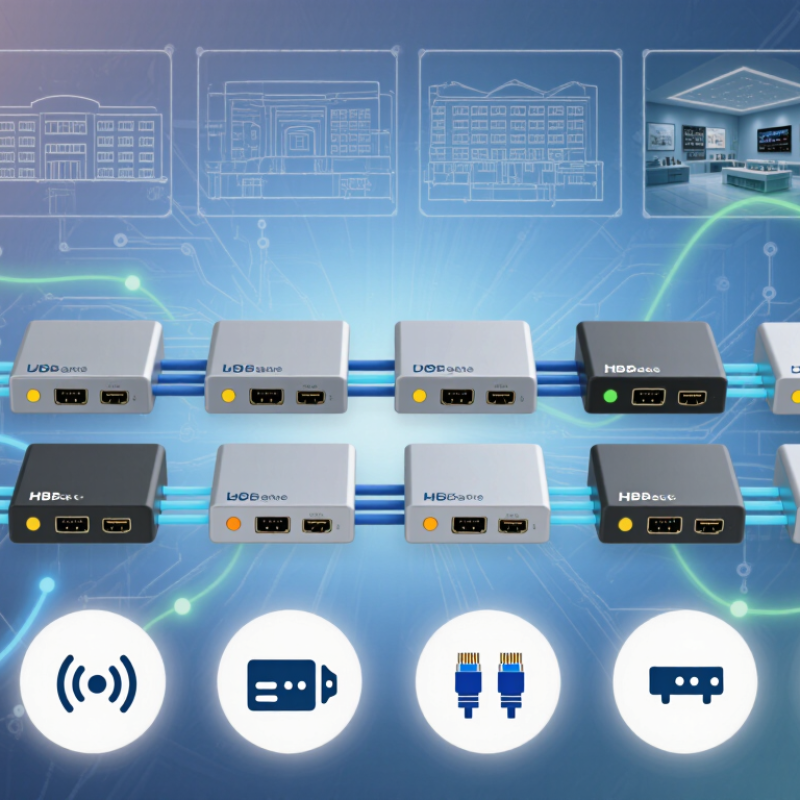
China Top 10 HDBaseT Extender Manufacturers?

What Is HDBaseT and Why Is It Used in AV Signal Extension?

What Is HDBaseT and Why Is It Used in AV Signal Extension?

HDBaseT is a professional AV transport standard that sends video, audio, control data, Ethernet, and power through one category cable. Its core design supports transmission distances of up to 100 meters over suitable twisted-pair infrastructure, according to HDBaseT technical specifications. That distance suits classrooms, hotels, hospitals, and control rooms, where displays may sit far from source equipment. One cable also reduces wall openings and rack congestion. It is practical, not magical.

The AV market is expanding. AVIXA’s 2024 Industry Outlook and Trends Analysis valued the global professional AV industry at more than 300 billion dollars in 2023. MarketsandMarkets’ 2024 research also identifies growing demand for long-distance, high-resolution signal distribution. These figures help explain HDBaseT’s continued relevance in integrated installations. However, installers still need to check cable category, shielding, connector quality, power limits, and electromagnetic conditions. A perfect specification can fail in a crowded ceiling pathway. That detail is often underestimated.

In field testing, stable results depend on matching the extender, cable, display, and source. HDBaseT can carry uncompressed signals with low latency, which benefits live teaching, surgical viewing, and conference presentation systems. It may not be the best option everywhere. AV-over-IP can scale more easily across large networks, while HDBaseT often offers simpler point-to-point deployment. The choice requires measurement, not assumption. Consult the current compliance documents and test the longest cable route before installation.

China Top 10 HDBaseT Extender Manufacturers? – What Is HDBaseT and Why Is It Used in AV Signal Extension?

A brand-neutral technical reference table for evaluating HDBaseT extender suppliers and product capabilities in China. Actual performance depends on the HDBaseT generation, chipset, cable quality, endpoint compatibility, and installation conditions.

No. Evaluation Dimension Typical HDBaseT Capability Why It Matters in AV Signal Extension Supplier Selection Checkpoint
1 Transmission Technology HDBaseT transports high-definition audio and video, Ethernet, control signals, USB, and power over twisted-pair cable in supported implementations. Multiple signal types can be carried through a single structured cable, reducing installation complexity and cable congestion. Confirm HDBaseT compliance
2 Recommended Cable Type Shielded or unshielded Cat 5e, Cat 6, or Cat 6A twisted-pair cable may be used, subject to the extender manufacturer’s specifications. Correct cable construction and termination help maintain signal integrity and reduce electromagnetic interference. Check cable category, shielding, connectors, and installation quality.
3 Maximum Transmission Distance Many HDBaseT systems support transmission distances up to 100 m over suitable twisted-pair cable; the supported resolution and functions may vary by model. A 100 m reach is suitable for classrooms, meeting rooms, retail spaces, hotels, and many commercial AV installations. Verify distance at the required resolution, refresh rate, and feature set.
4 Video Resolution HDBaseT 2.0 products commonly support 4K video with model-specific chroma and refresh-rate limitations. HDBaseT 3.0 products can support 4K at 60 Hz with 4:4:4 chroma in suitable implementations. Resolution, refresh rate, and chroma format determine whether the extender is suitable for presentation, signage, gaming, medical, or broadcast applications. Request a detailed resolution and bandwidth compatibility table.
5 Audio Transport HDBaseT can transport embedded digital audio together with the video signal. Supported formats depend on the transmitter, receiver, and connected equipment. Audio can remain synchronized with video without requiring a separate long-distance audio cable. Check support for the required surround, stereo, ARC, or eARC functions.
6 Control Signal Extension Supported systems may extend RS-232, infrared control, Consumer Electronics Control, and other control functions over the same link. Remote source selection, display control, automation, and system monitoring become easier in distributed AV installations. Confirm connector type, pin assignment, direction, and control protocol.
7 Ethernet Connectivity HDBaseT systems with an Ethernet channel can provide network connectivity through the extender pair. Network speed and topology are product-dependent. Network access can support connected displays, control processors, streaming devices, and system management without a separate cable run. Verify supported Ethernet speed, switch behavior, and network isolation requirements.
8 USB Extension HDBaseT 3.0 solutions may support USB extension, commonly for keyboard, mouse, touch, conferencing, or KVM applications. Functionality varies by model. USB extension enables remote control and interactive applications while keeping computers or media sources in a central equipment location. Check USB version, port count, bandwidth, and host-device compatibility.
9 Power over HDBaseT Some HDBaseT implementations provide power delivery over the twisted-pair link. The available power level and supported direction depend on the product design. Power delivery can reduce the need for a local power adapter at the receiver and simplify display or peripheral installation. Confirm power budget, polarity protection, endpoint compatibility, and safety certification.
10 Reliability and Certification Important factors include EDID management, HDCP compatibility, surge protection, thermal design, firmware support, EMC compliance, and production quality control. These features help minimize black screens, handshake failures, interference, overheating, and long-term maintenance issues. Request test reports and samples
Technical note: HDBaseT is not simply a longer HDMI cable. It is a standardized AV distribution technology designed to carry selected combinations of uncompressed video, audio, control, Ethernet, USB, and power over twisted-pair cabling. Before selecting a supplier, compare the exact supported resolution, distance, cable category, HDCP version, control functions, power requirements, certifications, warranty, and after-sales support.

How to Identify China’s Leading HDBaseT Extender Manufacturers

How to Identify China’s Leading HDBaseT Extender Manufacturers

China’s leading HDBaseT extender manufacturers should prove performance, not only display attractive specifications. Industry forecasts from MarketsandMarkets and Grand View Research show steady growth in professional audiovisual equipment, with annual growth commonly estimated near 5% to 7%. This trend increases supplier competition, but it also makes verification more important. Ask for test reports covering 4K resolution, HDCP compatibility, EDID control, PoC stability, and transmission distances up to 100 meters over suitable category cable. Request samples from the same production batch. A polished sample may not represent regular output.

Visit the factory, if possible. Check automated assembly, connector testing, burn-in procedures, and traceable serial records. Reliable manufacturers should explain thermal design, firmware updates, warranty handling, and failure rates. Independent laboratories can verify electromagnetic compatibility and safety compliance. Do not treat a certificate scan as complete evidence. Confirm its issuing body, product model, and validity. In real installations, a small issue with grounding or cable quality can cause intermittent black screens.

Tips: Compare suppliers using a written scorecard. Include optical stability, switching time, packaging, documentation, and technical response speed. The HDBaseT Alliance’s technical guidance is useful for checking feature claims. Still, standards do not guarantee manufacturing consistency. Some buyers focus too heavily on maximum distance. That is a mistake. Test the extender with your actual displays, cable routes, and control systems before placing a large order.

Profiles of China’s Top 10 HDBaseT Extender Manufacturers

China’s leading HDBaseT extender manufacturers differ in scale, testing depth, and market focus.

One established producer specializes in long-distance 4K video transmission. Its engineering team typically checks signal stability with standard network analyzers and simulated cable loads.

Another focuses on compact transmitters for classrooms, meeting rooms, and retail displays. Space is limited there.

A third manufacturer develops multi-input matrix systems, supporting centralized control across several rooms.

A fourth concentrates on PoC designs, reducing the number of power adapters installed behind displays.

A fifth serves professional integrators with rack-mounted extenders, labeled ports, and removable terminal blocks. Its documentation is usually more detailed.

A sixth builds cost-conscious models for distributors, but buyers should inspect thermal performance carefully. Lower price can hide weaker ventilation.

A seventh emphasizes fiber-assisted transmission for large venues and campuses.

A small eighth producer focuses on custom housings, unusual connector layouts, and private-label projects.

The ninth maintains a testing program for EDID, HDCP, audio return, and infrared control.

The tenth combines firmware development with hardware production, helping resolve compatibility issues faster.

Reliable evaluation requires more than a product page. Ask for measured transmission distance, supported resolutions, cable conditions, and operating temperature.

Request sample testing with the actual display, source, and control system. Certification documents should be current and traceable.

Some factory claims remain too general, especially when distance depends on cable quality. My own experience suggests that installation records reveal more than polished brochures.

Even experienced teams can overlook heat buildup inside a crowded cabinet. That weakness deserves honest review.

How the Top 10 Manufacturers Compare in Features and Applications

China Top 10 HDBaseT Extender Manufacturers?

The leading ten Chinese manufacturers differ more in deployment focus than basic transmission distance. Most support 4K video, RS-232, Ethernet, USB, and control signals through one twisted-pair cable. HDBaseT technical guidance defines the familiar 100-meter reach under suitable installation conditions. However, wall structure, cable quality, and power design can reduce real performance.

AVIXA’s 2024 Industry Outlook valued global professional AV revenue at about $332 billion in 2023. This growth supports demand in classrooms, hospitals, hotels, control rooms, and retail spaces. The strongest manufacturers usually separate products by application. Some emphasize low-latency switching for live production. Others prioritize PoC, fiber uplinks, video walls, or compact receivers for meeting rooms. Their differences appear in EDID management, HDR support, audio de-embedding, warranty terms, and remote diagnostics. A lower purchase price can hide higher commissioning costs. I have seen specifications look impressive, yet field testing exposed unstable handshakes.

Tips: Compare tested cable length, not the headline distance. Request thermal data, firmware history, and interoperability records. Check whether the unit supports your display’s refresh rate. A short demonstration should include source switching, power cycling, and long-duration playback. These details reveal more than a catalogue table.

China Top 10 HDBaseT Extender Manufacturers: Feature and Application Benchmark

This standards-based chart highlights the core capabilities commonly used to compare leading HDBaseT extender product lines. Transmission distances refer to HDBaseT Alliance specifications under suitable installation conditions, including compatible Category cable, connectors, and signal formats.

Reference: HDBaseT Alliance technology specifications. Actual performance varies by product design, cable quality, resolution, refresh rate, compression, and installation environment. This chart does not rank or disclose individual company data.

How to Choose the Right Chinese HDBaseT Extender Manufacturer

Choosing the right Chinese HDBaseT extender manufacturer requires more than comparing prices. AVIXA’s 2024 Industry Outlook values the professional AV market at over US$300 billion annually, with continued growth forecast through 2028. That expansion increases supplier options, but quality still varies. Ask for verified test reports, product revision records, and clear warranty terms. A reliable manufacturer should explain signal distance, bandwidth, HDCP support, EDID handling, and latency in practical terms. Request a live demonstration with your actual display, cable length, and source devices.

My factory evaluations taught me one uncomfortable lesson: a polished showroom proves very little. I once considered too many suppliers before checking their engineering response time. That was a mistake. Review production capacity, incoming inspection procedures, burn-in testing, and failure rates. ISO 9001 certification can support credibility, but it does not replace independent product testing. Request samples from different production batches. Compare connector strength, heat control, firmware stability, and recovery after power interruption. Small details matter in conference rooms and control centers.

Tips: Build a technical scorecard before requesting quotations. Check whether the manufacturer offers firmware updates and remote troubleshooting. Confirm packaging protection for long-distance shipping. Ask for three customer references, but verify them independently. If a supplier avoids difficult questions, pause. The cheapest extender may become the most expensive installation problem.

Member of

Associated Wire Rope FabricatorsMHI MemberNetPlus Alliance Member Steel Erectors Assocation STADFA member

Terms of Sale | Privacy Policy