
Choosing the right Shelf Panel is more complicated than comparing thickness and price. Global buyers must examine load capacity, humidity, surface durability, edge protection, packaging, and replacement availability. A panel used in a dry showroom may fail in a coastal warehouse. Small details matter. A chipped corner can damage the whole presentation.
Shelf-panel engineer Martin Keller puts it clearly: “A panel is never only a board; it is a load path, a surface, and a customer touchpoint.” This view supports a practical comparison of ten common types, including melamine board, MDF, particleboard, plywood, solid wood, metal, glass, slatwall, pegboard, and wire panels. Each option serves a different commercial purpose. Glass improves visibility. Metal handles demanding loads. Plywood offers strength with a natural edge. Melamine provides consistent color and simple cleaning.
However, no universal winner exists. That conclusion is easy to write and difficult to apply. Buyers should question supplier claims, especially when test conditions are unclear. Ask for core density, bending strength, coating details, moisture resistance, and packaging photographs. Request samples when possible. A white panel can look excellent under showroom lighting, yet reveal uneven edging under warehouse inspection.
This guide compares the ten Shelf Panel types through practical buying factors. It considers retail displays, storage systems, furniture production, and export conditions. The goal is not to promote one material. It is to help buyers match panel performance with real operating conditions, realistic budgets, and long-term maintenance needs.
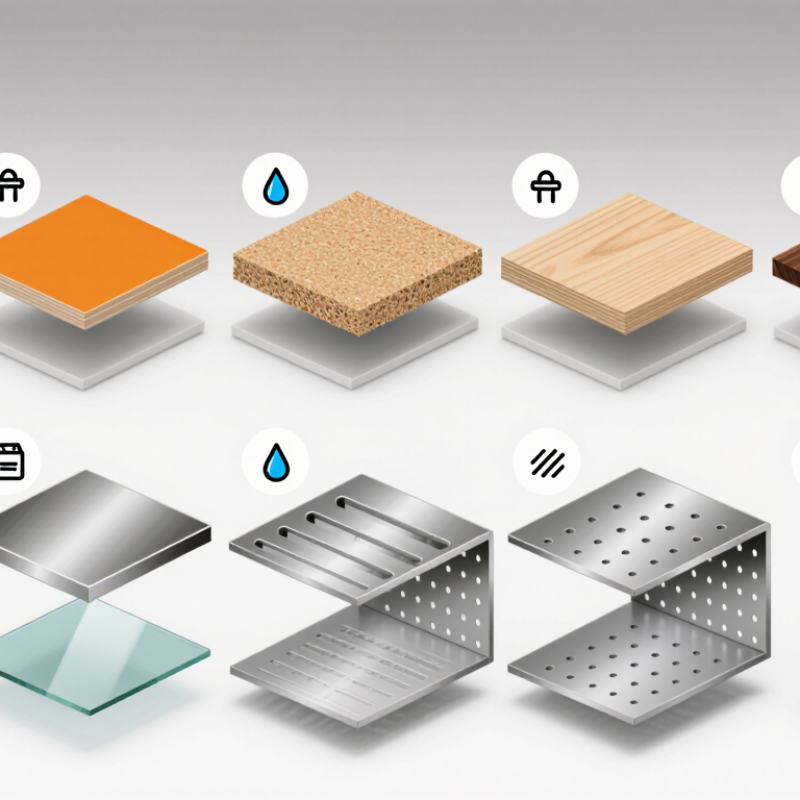
Material choice controls strength, weight, appearance, and service life. Solid wood panels offer natural grain for homes, boutiques, and hospitality interiors. Plywood panels resist splitting and suit heavy storage or repeated assembly. Particleboard remains economical for office and retail furniture, although moisture can weaken exposed edges. Medium-density fiberboard provides a smooth surface for painted shelves and display fixtures. Tempered glass creates visual lightness in bathrooms, kitchens, and premium showcases. Metal panels, including steel and aluminum, support industrial storage and commercial back rooms. It feels light.
Structure changes performance. Slotted panels allow adjustable brackets for changing merchandise layouts. Perforated panels accept hooks and accessories in tool, hardware, and convenience stores.
Wire panels improve airflow and reduce visual weight, making them useful for kitchens and utility areas. Laminate-faced panels add scratch resistance and consistent color for busy retail environments.
In practical inspections, edge treatment often matters more than the surface finish. Sealed edges help protect wood-based boards from cleaning water and humid air. Load capacity also depends on span, bracket spacing, fixing quality, and wall construction. A thick panel may still sag across a wide opening. I once underestimated this detail during a storage review. The shelf looked strong but bowed under boxed equipment.
Buyers should request load data, moisture limits, tolerances, and test methods. Local climate and installation skill can change the final result. Some specifications remain incomplete. That deserves careful questioning.

Global buyers can choose from ten practical panel types: particleboard, MDF, HDF, plywood, OSB, laminated particleboard, melamine-faced panels, veneered panels, moisture-resistant boards, and recycled-content panels. FAO’s Forestry Production and Trade database recorded about 373 million cubic metres of wood-based panel production in 2022. This scale shows why panel selection matters across furniture, retail, and residential storage.
Particleboard offers economical shelving for dry rooms. MDF gives smoother edges for painted interiors. Plywood performs better where screw holding and strength matter. OSB suits utility storage, although its visible texture needs careful finishing. Melamine-faced panels reduce finishing work and support consistent cleaning. HDF works well for thinner components, but it may increase cost. Moisture-resistant grades help kitchens and laundry areas. They are not waterproof. Veneered panels add natural grain, while recycled-content boards support material efficiency.
Testing should match the real shelf. Measure span, thickness, fastener type, humidity, and expected load. EN 312 classifies particleboard performance, while formaldehyde limits under applicable regulations support safer indoor use. The U.S. Environmental Protection Agency’s TSCA Title VI framework is a useful compliance reference for international shipments. In practice, I have seen attractive shelves fail because buyers ignored sagging over long spans. No panel wins every room. A small error remains possible when laboratory ratings meet uneven walls, careless installation, or overloaded storage.
Global buyers often compare shelf panels by load rating, visibility, cleaning effort, and installation speed. Among the top ten panel types, metal, glass, and wire options suit different selling environments. A hardware aisle needs dependable support for dense cartons. A display area may need clearer sightlines. The panel should fit the shelf frame, not merely look attractive.
Metal panels suit heavier products and frequent replenishment. Powder-coated steel resists everyday scratches and supports stable weight distribution. Check the panel gauge, edge finish, and fixing points before ordering. Sharp edges can slow installation and create avoidable handling risks. Perforated metal adds ventilation and adjustable mounting, but small items may slip through. That detail is easy to miss.
Glass panels improve visibility in retail displays and allow light to reach lower shelves. Tempered safety glass is practical where customers browse closely. Confirm thickness, supported span, and corner protection with the supplier. Glass can show dust quickly. Wire panels are lighter, easier to reposition, and useful for baskets, packaged goods, and airflow-sensitive storage. Their open structure improves visibility, yet narrow packaging may lean or fall. Not every “universal” panel fits every bracket. Measure twice. Trial loading matters. A small pilot order can reveal deflection, glare, or cleaning problems before a global rollout.
Typical commercial specifications for retail fixtures, industrial shelving, storage systems, and display applications
| Panel Type | Common Material | Typical Thickness or Wire Diameter | Typical Open Area / Transparency | Typical Load Capacity* | Visibility | Main Advantages | Typical Uses |
|---|---|---|---|---|---|---|---|
| Perforated Metal Panel | Cold-rolled steel, galvanized steel, or aluminum | 0.8–2.0 mm sheet thickness | 30–60% open area, depending on hole pattern | Approximately 50–150 kg per shelf | Medium to high; products remain partially visible | Strong, lightweight relative to solid sheet, and suitable for ventilation | Retail shelving, cabinets, tool storage |
| Expanded Metal Panel | Low-carbon steel, stainless steel, or aluminum | 0.8–2.5 mm sheet thickness | 35–75% open area, based on mesh geometry | Approximately 60–180 kg per shelf | High; open diamond mesh provides clear product recognition | Good rigidity, airflow, drainage, and resistance to impact | Warehouse racks, retail displays, utility shelving |
| Wire Grid Panel | Welded carbon-steel wire with powder coating or plating | 3.0–6.0 mm wire diameter | Approximately 60–85% open area | Approximately 40–120 kg per shelf | Very high; products are visible from multiple angles | Low weight, excellent air circulation, and easy cleaning | Supermarkets, coolers, baskets, display racks |
| Wire Mesh Decking Panel | Welded steel wire with galvanized or powder-coated finish | 4.0–8.0 mm wire diameter | Approximately 50–75% open area | Approximately 250–1,000 kg per shelf level | High; stored goods remain identifiable through the mesh | High load distribution, improved sprinkler visibility, and ventilation | Pallet racking, warehouse shelving, industrial storage |
| Solid Steel Panel | Cold-rolled steel or stainless steel | 0.7–2.0 mm sheet thickness | 0% open area | Approximately 80–250 kg per shelf | Low from below; fully supports opaque or small items | High stiffness, secure containment, and resistance to small-item fall-through | Heavy-duty shelving, cabinets, workshops |
| Tempered Glass Panel | Heat-treated soda-lime safety glass | 5–10 mm glass thickness | Approximately 85–92% light transmission for clear glass | Approximately 20–60 kg per shelf | Very high; unobstructed view of displayed products | Premium appearance, easy visual merchandising, and corrosion-free surface | Retail displays, showcases, home interiors |
| Laminated Glass Panel | Two glass sheets bonded with a plastic interlayer | Approximately 6.4–13.5 mm total thickness | Approximately 80–90% light transmission for clear configurations | Approximately 20–60 kg per shelf | Very high; transparent construction maintains product visibility | Better post-breakage retention than monolithic glass and good acoustic performance | Premium shelving, showcases, architectural displays |
| Acrylic Panel | Cast or extruded polymethyl methacrylate (PMMA) | 3–8 mm sheet thickness | Approximately 90–92% light transmission for clear acrylic | Approximately 10–40 kg per shelf | Very high; clear surface provides strong product visibility | Much lighter than glass, easy to fabricate, and resistant to shattering | Light-duty displays, cosmetics, signage, point-of-sale fixtures |
| Polycarbonate Panel | Clear or translucent polycarbonate sheet | 3–10 mm sheet thickness | Approximately 80–90% light transmission for clear grades | Approximately 15–50 kg per shelf | High; clear grades provide broad viewing angles | High impact resistance, low weight, and better safety for demanding environments | Industrial displays, transport interiors, retail fixtures |
| Slotted Metal Panel | Cold-rolled steel or aluminum with formed slots | 0.8–1.5 mm sheet thickness | Approximately 10–35% open area | Approximately 40–120 kg per shelf | Medium; front and side visibility depends on slot arrangement | Adjustable accessories, efficient merchandising, and good panel stiffness | Wall shelving, pegboard systems, retail fixtures |
*Load capacities are typical indicative ranges for evenly distributed loads on properly supported panels. Actual capacity depends on panel span, support spacing, edge reinforcement, mounting method, material grade, and applicable safety factors. Verify the final design against relevant local standards and supplier test data.
Top 10 Shelf Panel Types for Global Buyers
Plastic, Composite, and Specialty Panels for Global Markets
Shelf panels vary widely in strength, weight, moisture resistance, and finishing options. For global buyers, the main choices include injection-molded plastic, blow-molded plastic, recycled plastic, PVC foam, HDPE, ABS, wood-plastic composite, honeycomb composite, phenolic resin, and mineral-based panels.
Injection-molded panels offer clean edges and repeatable dimensions. Blow-molded panels reduce weight through internal cavities. Recycled plastic supports material efficiency, but color and surface consistency may vary. PVC foam panels are easy to machine and resist moisture. HDPE performs well in damp storage areas. ABS provides a smooth, impact-resistant surface. Wood-plastic composite adds a warmer appearance, although it can be heavier. Honeycomb panels are lightweight and suitable for longer spans. Phenolic resin panels resist moisture and daily abrasion. Mineral-based panels suit projects requiring better heat performance.
A practical evaluation should include the expected load, shelf span, fastener type, and local climate. Humid warehouses expose weak edges quickly. Temperature changes can also cause expansion or slight warping. I have seen buyers focus on panel thickness while overlooking support spacing. That mistake can reduce real-world capacity.
Ask for load testing, dimensional tolerances, surface samples, and packaging details. Supplier documentation should identify recycled content, maintenance needs, and applicable market requirements. No panel fits every application. Some lower-cost options look efficient initially, but replacement and shipping costs may change the calculation.
Top 10 Shelf Panel Types for Global Buyers
Selection Criteria: Load Capacity, Standards, Cost, and Sustainability
Global buyers commonly compare particleboard, MDF, plywood, solid wood, steel, wire, glass, plastic, aluminum, and honeycomb panels. Each type behaves differently under weight, humidity, and repeated use. A 900-millimeter particleboard shelf may hold books safely with proper thickness and support spacing. However, its edges can swell after water exposure. Plywood generally offers better screw retention and strength-to-weight performance. Steel panels resist heavy loads, but they add weight and may require corrosion protection.
Load capacity should come from tested data, not appearance. Check the distributed-load rating, deflection limit, support distance, and fixing method. Details matter. A panel can pass a factory test yet fail after incorrect installation. Request test reports that match the destination market’s requirements, such as relevant furniture, structural, or electrical safety standards. Requirements differ between regions, so one certificate rarely covers every application.
Cost includes packaging, shipping weight, replacement rates, and installation time. A cheaper MDF panel may become expensive when moisture damage causes returns. Sustainability also needs evidence: recycled content, responsible wood sourcing, low-emission adhesives, and recyclable metal components. Ask for current declarations and chain-of-custody records. Keep samples. Surface finishes often hide weak cores, and sustainability claims can be incomplete. In practice, buyers should compare full service life, not only the purchase price. I would also recheck panel thickness after delivery, because specifications sometimes drift between sample approval and mass production.
Selection benchmark: load capacity, standards readiness, cost efficiency, and sustainability.
The chart uses a comparative 0–100 planning index. Load capacity reflects typical performance at comparable shelf spans; standards readiness considers the availability of commonly used EN, ISO, and ASTM testing frameworks; cost efficiency rewards lower material and processing costs; sustainability considers recyclability, recycled content potential, durability, and embodied impact. Final selection should be verified against panel thickness, span, moisture exposure, safety factor, and local regulations.
Copyright ©2024 Elephant Lifting Products | All rights reserved.
38381 N Robert Wilson Rd, Gonzales, LA 70737 USA
Toll Free: (888) 844-6113 | Phone: (225) 644-6113 | Fax: (225) 644-6695
Email: sale@floralift.org