Choosing the right Electric Chain Hoist requires more than comparing lifting capacity and purchase price. Global buyers often work across warehouses, workshops, production lines, and maintenance sites. Each setting creates different demands. A compact hoist may suit a light-duty workstation, while a heavy-duty model may be necessary for repeated lifting near its rated load.
This guide examines ten Electric Chain Hoist types commonly considered by international purchasers. It compares lifting capacity, duty classification, lifting speed, control methods, chain containers, voltage options, installation style, and environmental protection. Practical selection also depends on available power, headroom, operating frequency, and maintenance access. Small details matter. A low-clearance design can save valuable space, while an adjustable-speed model may improve load positioning and reduce sudden movement.
Reliable decisions should include manufacturer documentation, inspection procedures, spare-parts support, and applicable safety requirements. Product claims still deserve verification. A higher rating does not automatically mean better performance for every application. Buyers should review test certificates, technical drawings, warranty terms, and service response before ordering. Some comparisons may remain imperfect because regional standards and working conditions differ. That limitation deserves attention.
The following overview is designed to help engineers, distributors, contractors, and purchasing teams narrow their choices with greater confidence. It focuses on practical differences rather than attractive specifications alone. Real performance depends on correct installation, trained operators, regular inspections, and disciplined load handling. Choose carefully. Reliability is built over time.
Top 10 Electric Chain Hoist Types for Global Buyers
Electric chain hoists lift loads through an electrically driven chain wheel and load chain. Their basic parts include a motor, gearbox, brake, hook, chain bag, and pendant control. Buyers should classify models by rated capacity, lifting speed, duty cycle, lift height, power supply, and operating environment.
The main types include single-speed, dual-speed, variable-speed, low-headroom, explosion-protected, stainless-steel, corrosion-resistant, trolley-mounted, fixed, and synchronized hoists. ISO 4301-1 classifies lifting machinery by utilization and load spectrum. This matters because a workshop hoist may fail early under frequent production cycles. Check working time, starts per hour, and average load.
The International Labour Organization reported 2.93 million work-related deaths annually in its 2023 global estimates. Safe hoist selection therefore needs more than maximum capacity. Confirm chain grade, brake performance, overload protection, emergency stopping, and inspection access. A 2-ton hoist is not automatically suitable for every 2-ton load. Center of gravity, impact loading, and side pulling can change the real risk. I would also question marketing claims about “heavy duty” service. Ask for test certificates, duty classification, maintenance intervals, and measurable noise data. Classification is technical, but the worksite remains imperfect.
The chart compares representative rated-capacity reference points commonly used when classifying electric chain hoists by suspension method, lifting configuration, operating environment, and control features. Fixed and lug-mounted units are generally selected for compact lifting stations, while trolley-mounted and double-chain designs support higher capacities or greater installation flexibility. Actual capacity, lifting speed, duty class, and hazardous-area suitability must be verified against the applicable technical standard and the hoist’s specification.
Capacity figures are indicative reference values in metric tonnes, not brand-specific product limits.
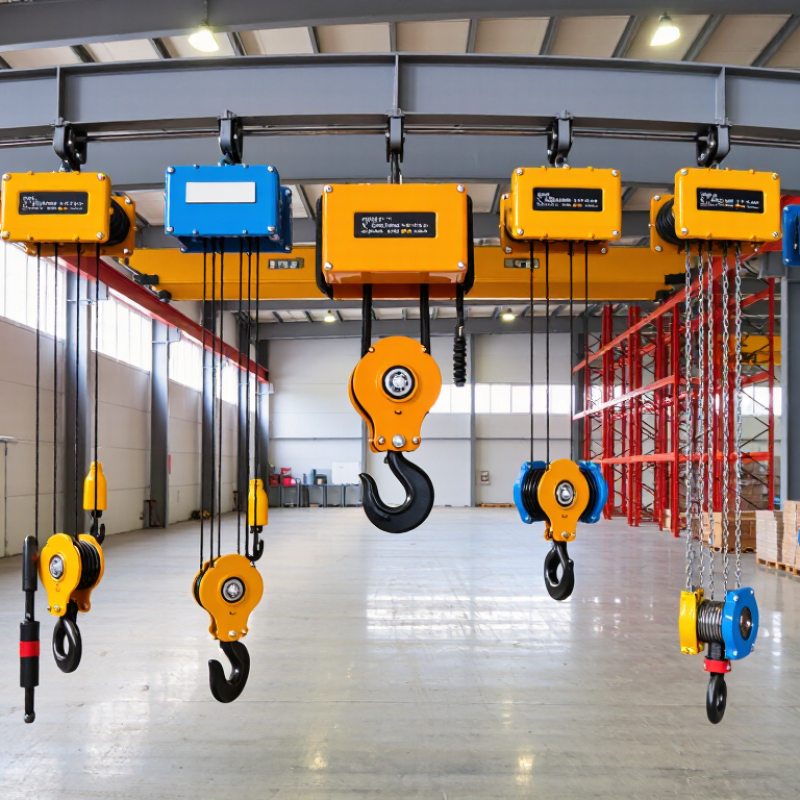
Electric chain hoists differ mainly by design, control, mounting method, and lifting purpose. The ten common types include fixed, push-trolley, geared-trolley, low-headroom, dual-speed, variable-frequency, high-speed, precision-lifting, corrosion-resistant, and hazardous-area models. Fixed hoists suit permanent workstations, while trolley versions move loads along runway beams. Low-headroom designs help when ceiling clearance is limited.
Dual-speed hoists support faster travel and slower positioning. Variable-frequency units provide smoother starts, which can reduce swinging around fragile machinery.
Precision-lifting models are useful for assembly work, where millimeter-level control matters. High-speed designs improve repetitive handling, but speed may increase load movement and stopping distance. That trade-off is often underestimated.
According to Grand View Research’s 2024 market analysis, the global electric hoist market is projected to grow at roughly 5.8% annually through 2030. This growth reflects wider demand for safer and more efficient material handling. MarketsandMarkets also identifies construction, manufacturing, and warehousing as major application sectors.
Buyers should compare rated capacity, lifting height, duty class, chain grade, brake performance, and control voltage. A five-ton rating alone proves little. Duty classification matters more than many catalogs suggest.
I have seen specifications that look suitable until headroom, duty cycles, or ambient temperature are checked. The categories also overlap, so selecting by lifting function is usually more reliable than choosing by appearance.
Choosing an electric chain hoist starts with load data, not price. Common types include single-speed, dual-speed, variable-frequency, low-headroom, stainless-steel, outdoor, clean-room, corrosion-resistant, hazardous-area-rated, and heavy-duty models. Typical capacities range from 125 kilograms to 10 tonnes, although exact limits depend on design and duty class. Check the working load limit, lifting height, chain size, motor power, brake performance, and control voltage. A 2-tonne hoist may lift the load, but its structure must also support dynamic forces.
Operating conditions change the specification. Indoor workshops may need IP54 protection, while dusty or wet areas often require higher ingress protection. Outdoor installations need weather-resistant housings, stable controls, and protection against temperature changes. Food and pharmaceutical spaces may require smooth surfaces and cleanable components. Hazardous locations demand certified equipment matched to the site classification. Local electrical rules still apply; a familiar voltage is not automatically suitable.
Duty cycles deserve careful review. Frequent starts, long lifting distances, and hot environments can reduce motor life. Low-headroom units fit beneath restricted beams, while dual-speed models improve load positioning. Variable-frequency control can reduce swinging, but it adds setup complexity. A common buying mistake is selecting capacity without checking headroom and structural loads. That feels efficient. It often is not. Inspectors should verify test certificates, chain condition, emergency-stop access, and maintenance intervals before operation.
Top 10 Electric Chain Hoist Types for Global Buyers
How to Select the Right Electric Chain Hoist for Global Applications
Choosing an electric chain hoist starts with the load, not the catalog photograph. Record the working load, lift height, lifting speed, duty cycle, and daily starts. For example, a 2-ton hoist lifting steel coils all day needs a different duty rating from a 500-kilogram workshop unit. Select the correct voltage and frequency for the destination country. Check control voltage, plug design, brake holding capacity, and emergency-stop access. Small details matter.
The International Labour Organization reported 2.93 million work-related deaths annually in 2023. That figure makes overload protection, upper-limit switches, chain inspection, and brake testing essential. For humid ports, choose suitable enclosure protection and corrosion-resistant components. For dusty factories, review thermal limits and ingress protection carefully. Outdoor lifting also requires wind exposure assessment and protected pendant controls.
International market analyses commonly identify construction, manufacturing, warehousing, and energy as major demand sectors. Yet application labels can mislead. A warehouse hoist may face frequent starts, while a fabrication shop may impose shock loading. Match the hoist’s duty classification with real operating records, not optimistic estimates. I still see buyers focusing on purchase price first. That often creates costly compromises in maintenance, spare-chain availability, and operator training. Ask for test certificates, inspection procedures, load-test evidence, and service documentation before approval. Local support can matter more than a slightly higher rated capacity.
Electric chain hoists differ in lifting capacity, duty class, speed, control method, and installation style. Global buyers should match each type to its actual workload, not its advertised maximum. A workshop hoist may lift 500 kilograms safely, while a production hoist needs stronger duty ratings and better heat control. Small details matter.
Safety begins with recognized standards. Check requirements such as ASME B30.16, EN 14492-2, or IEC 60204-32, depending on the destination market. Certification marks alone are not enough. Request test reports, declarations of conformity, load-test records, and certificate scopes. Confirm that voltage, emergency stops, overload protection, hooks, chains, and brakes meet local rules. A certificate can cover one model, not every configuration.
Maintenance records reveal more than brochures. Inspect the load chain for elongation, corrosion, stiff links, and unusual noise. Test the brake and upper limit switch before demanding full capacity. Lubricate according to the manual, and keep pendant controls dry. Buyers should also review spare-part access, technician training, warranty terms, and inspection intervals. In practical inspections, paperwork is sometimes perfect while chain wear is ignored. That mistake is easy to make. A sensible purchase includes a written lifting plan, operator training, and a realistic duty cycle. Never select capacity by weight alone; shock loading and frequent starts can change the risk.
| No. | Electric Chain Hoist Type | Typical Capacity & Lift | Typical Duty & Applications | Main Safety Features | Relevant Standards & Certification Routes | Maintenance Priorities | Key Buyer Considerations |
|---|---|---|---|---|---|---|---|
| 1 | Standard Single-Speed Hoist | Commonly 0.5–5 t; lift lengths are normally configured to the installation. | General workshops, warehouses, machine maintenance, and light-to-medium material handling; usually intermittent duty. | Electromagnetic brake, upper and lower limit devices, overload protection, emergency stop where required, and load-rated suspension. | EN 14492-2, ASME B30.16, IEC/EN 60204-32, and ISO 4301-1 duty classification as applicable; CE or UKCA conformity may apply by market. | Inspect chain, hook, brake, limit switches, pendant, fasteners, and electrical connections; lubricate the load chain according to the manual. | Confirm rated load, lift speed, duty group, power supply, headroom, suspension method, chain container size, and local inspection rules. |
| 2 | Two-Speed Hoist | Commonly 0.5–10 t; low speed is used for positioning and high speed for travel. | Fabrication, assembly, maintenance, and loading operations requiring faster cycle times with controlled final placement. | Fail-safe brake, overload limiter, travel or lifting limit devices, pendant controls, and speed-change logic that prevents unsafe switching. | EN 14492-2, IEC/EN 60204-32, ASME B30.16, and applicable electrical conformity requirements; verify the declared duty class. | Check contactors or electronic controls, brake response, speed selection, chain wear, hook deformation, and thermal protection. | Compare low-speed accuracy, transition smoothness, control voltage, duty cycle, noise, replacement control parts, and operator training needs. |
| 3 | Variable-Frequency Drive Hoist | Commonly 1–20 t; speed range depends on motor, gearbox, load, and control settings. | Precision assembly, die handling, production lines, and applications requiring smooth acceleration and deceleration. | Controlled acceleration, reduced shock loading, monitored brake control, overload protection, upper/lower limits, and programmable speed limits. | EN 14492-2, IEC/EN 60204-32, ASME B30.16, and EMC/electrical conformity requirements applicable to the destination market. | Check drive fault history, cooling, parameter backups, brake timing, encoder or sensor condition where fitted, and electrical insulation. | Assess control-system compatibility, harmonic and EMC requirements, braking behavior, operator interface, service capability, and software access. |
| 4 | Low-Headroom Hoist | Commonly 0.5–10 t; lift and capacity are selected around available overhead clearance. | Facilities with restricted ceiling height, indoor cranes, production cells, and maintenance bays. | Load-rated suspension, positive brake, upper limit protection, overload device, anti-drop measures, and adequate hook clearance. | EN 14492-2, ASME B30.16, IEC/EN 60204-32, and structural requirements for the supporting runway or beam. | Inspect compact trolley or suspension components, side plates, chain guide, hook throat, brake, and clearances throughout the lift path. | Measure available headroom and side clearance before ordering; verify beam dimensions, trolley flange range, hook approach, and service access. |
| 5 | Fixed-Suspension Hoist | Commonly 0.25–10 t; fixed lift point with no powered horizontal movement. | Workstations, jib cranes, monorail points, service platforms, and repetitive vertical lifting at one location. | Rated suspension eye or hook, mechanical brake, overload protection, limit switches, and secure anchorage designed for dynamic loading. | EN 14492-2, ASME B30.16, IEC/EN 60204-32, and applicable structural design and lifting-equipment rules. | Inspect the suspension point, mounting bolts, pin or eye, chain, hook, brake, controls, and load-bearing structure. | Confirm the supporting structure’s safe working load, installation orientation, hook travel, pendant reach, and whether future horizontal movement is needed. |
| 6 | Motorized Trolley-Mounted Hoist | Commonly 0.5–20 t; lift capacity and trolley speed must be matched to the runway. | Material transfer along beams, production lines, storage areas, workshops, and overhead handling systems. | Trolley brakes, travel limits where required, overload protection, anti-collision provisions, emergency stop, and secure power collection. | EN 14492-2, ASME B30.16, IEC/EN 60204-32, and runway or crane standards applicable to the complete installation. | Inspect wheels, gears, bearings, flange clearance, power cable or conductor system, travel brake, chain, and runway condition. | Verify beam flange range, curve capability, travel speed, power supply, end stops, wheel load, headroom, and total system capacity. |
| 7 | Explosion-Protected Hoist | Commonly 0.25–10 t; capacity and duty depend on the hazardous-area design. | Facilities with flammable gas, vapor, mist, or combustible dust hazards, subject to formal area classification. | Protected electrical enclosure, temperature control, grounding or bonding, suitable brake and motor design, and certified components for the stated zone. | ATEX Directive 2014/34/EU or IECEx certification where applicable; equipment category, EPL, gas or dust group, and temperature class must match the area. | Use only approved replacement parts; inspect enclosure integrity, cable glands, grounding, surface temperature, brake, chain lubrication, and certification markings. | Obtain the hazardous-area classification first; confirm gas or dust group, zone, temperature class, ambient range, certification documents, and maintenance restrictions. |
| 8 | Corrosion-Resistant or Stainless-Steel Hoist | Commonly 0.25–5 t; actual capacity depends on enclosure, chain, and environmental design. | Coastal areas, washdown locations, wastewater facilities, chemical environments, food processing, and humid plants. | Sealed controls, corrosion-resistant finishes or materials, protected electrical parts, load brake, limit devices, and suitable ingress protection. | EN 14492-2, IEC/EN 60204-32, ASME B30.16, and an appropriate IP rating under IEC 60529; hygiene requirements may require additional assessment. | Rinse or clean as permitted, inspect pitting and galvanic corrosion, check seals and cable glands, lubricate correctly, and verify brake performance. | Specify chemical exposure, washdown pressure and temperature, humidity, salt atmosphere, IP rating, material grades, drainage, and compatible lubricants. |
| 9 | Cleanroom or Hygienic Hoist | Commonly 0.125–5 t; cleanroom suitability depends on the complete installed system. | Pharmaceutical, medical, semiconductor, laboratory, and controlled food-production environments. | Low-particle surfaces, enclosed or sealed components, controlled lubricants, smooth cleanable finishes, and electrical protection suitable for the room. | EN 14492-2, IEC/EN 60204-32, IEC 60529 IP rating where relevant, and site-specific cleanroom or hygienic design validation requirements. | Follow contamination-control procedures; inspect seals, surface finish, chain cleanliness, lubricant compatibility, particle generation, and documentation. | Define cleanroom classification, cleaning agents, allowable particles, lubricant requirements, surface roughness, noise limits, and validation documentation. |
| 10 | Outdoor and Heavy-Duty Hoist | Commonly 1–20 t; higher capacities may require engineered multi-hoist or special systems. | Construction support, utilities, ports, steelwork, outdoor maintenance, and frequent or severe industrial lifting. | Weather-protected enclosure, thermal protection, fail-safe brake, overload limiter, emergency stop, limit devices, grounding, and rated outdoor suspension. | EN 14492-2, ASME B30.16, IEC/EN 60204-32, IEC 60529 IP rating, ISO 4301-1 duty classification, and local wind or structural requirements. | Inspect corrosion, water ingress, enclosure seals, cable glands, chain and hook wear, brake lining, gearbox oil where applicable, and storm protection. | Evaluate wind, rain, salt, dust, temperature, UV exposure, drainage, parking position, power quality, duty cycle, and spare-parts availability. |

Copyright ©2024 Elephant Lifting Products | All rights reserved.
38381 N Robert Wilson Rd, Gonzales, LA 70737 USA
Toll Free: (888) 844-6113 | Phone: (225) 644-6113 | Fax: (225) 644-6695
Email: sale@floralift.org